A Quiet Morning Shattered
Residents of Bayham, Ont., are no strangers to winter’s early-morning stillness, but Friday’s calm broke in an instant. At 10:36 a.m. on Dec. 5, 2025, a powerful blast tore through a home on Sandytown Line in southeast Elgin County—an explosion so forceful that locals described it as “almost like a sonic boom.” Yet what followed may be even more perplexing: there was no fire.
Provincial fire investigators, police, and technical specialists have now launched an extensive inquiry into the rare incident. Their task is complicated not by what they found, but by what they didn’t.
A Blast Felt for Kilometres
Eyewitness Descriptions Capture the Shock
Bayham Mayor Ed Ketchabaw was at home roughly 700 metres away when the sound struck.
“It rattled the windows,” he said, still sounding astonished hours later. Neighbours reported hearing the same thunderous crack as far away as Baldwin Line, with accounts describing vibrating floors and startled pets scrambling for cover.
One resident compared the noise to “a quarry detonation crossed with a freight train,” a metaphor that might have seemed exaggerated if not for the house now reduced to rubble.
In a community where most startling sounds involve farm machinery or the occasional coyote chorus, the blast left residents frozen in place. As one joked, “If this is what a sonic boom really sounds like, I want a refund on every movie I’ve ever watched.”
First Responders Arrive to an Unusual Scene
Firefighters Expect Flames—But There Are None
Shortly after the explosion, multiple fire crews from Bayham Fire & Emergency Services (BFES) converged on the scene, along with the Elgin County OPP. What they found contradicted decades of experience.
“We had a house that exploded,” Fire Chief Harry Baranik explained. “But the unusual event was there’s absolutely no fire to this.”
Baranik, who has encountered a handful of explosions over his career, noted that every previous case involved flames. “This is very unusual—it blew itself out,” he said, emphasizing the rarity.
A Swift Exit to Preserve Critical Evidence
Once firefighters confirmed there were no flames and no victims inside—a discovery made possible by quickly contacting the owner—they withdrew. The home was vacant, having been sold just days earlier, with the new occupants taking possession on Dec. 1.
Preserving the scene intact became the top priority. The Ontario Fire Marshal’s office (OFM) was immediately notified, along with the Technical Standards and Safety Authority (TSSA), which oversees fuel-related systems in the province. The possibility of multiple contributing factors meant only a meticulous investigation would do.
Baranik stressed that vacating the scene was not typical, but essential. “We were able to keep everything in place for the OFM. That’s critical when the cause is unknown.”
A Methodical Investigation Begins
Sifting Through Debris for Answers
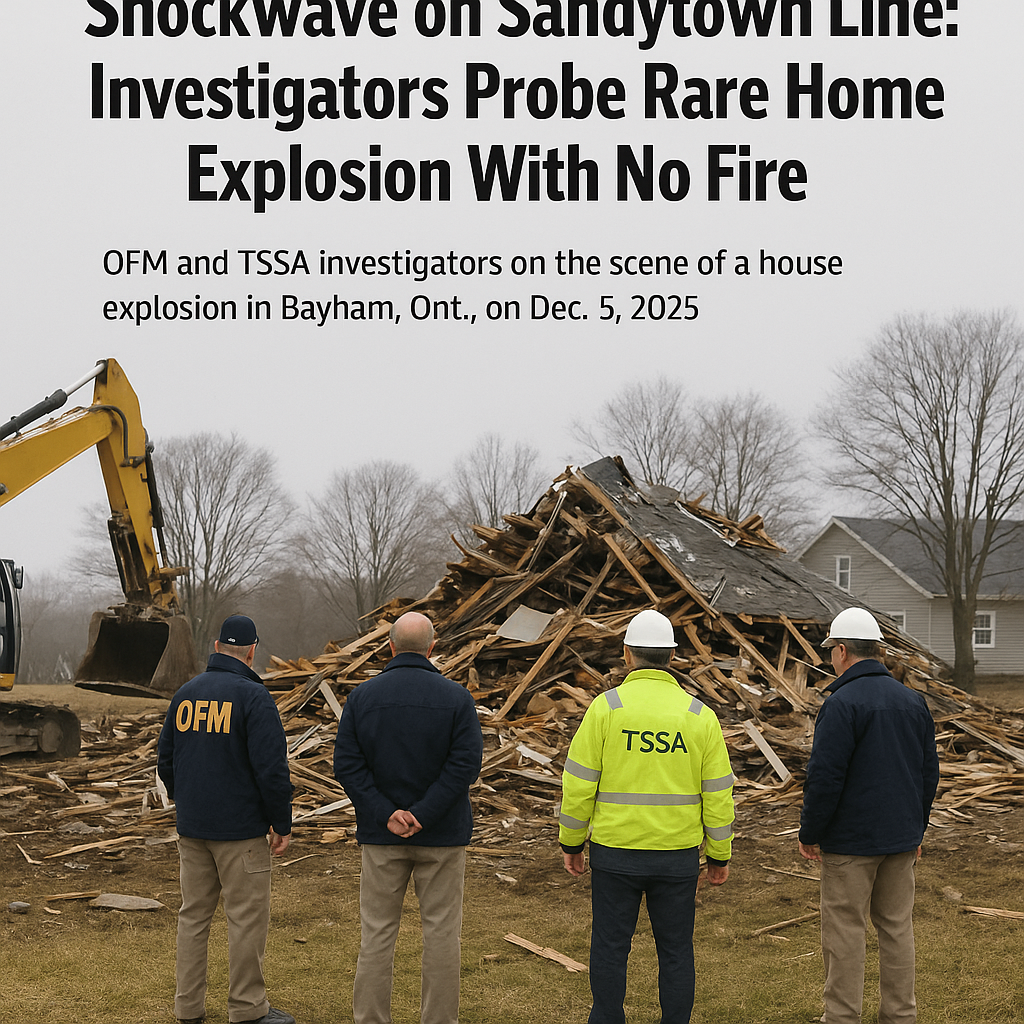
By midday, OFM investigators, accompanied by TSSA specialists, were walking the site—though “walking” may be generous. The home had collapsed into a chaotic mass of debris, requiring heavy machinery just to allow inspectors safe access.
“What we will be doing is a methodical approach,” said OFM spokesperson Jim Demetriou. “We’ll be fine-combing through everything, turning each piece to ensure we can find the origin and cause.”
He described the process as slow, deliberate, and painstaking. While members of the public often hope for quick answers, the reality resembles archaeological work more than detective fiction.
A Timeline Still Unknown
As for how long the investigation will take, Demetriou offered no estimate.
“Once the excavator starts removing parts, it becomes difficult to determine a timeline,” he said. “We must continue until we have gathered everything necessary to understand what caused the explosion.”
Anyone who has ever tried to locate the source of a strange smell in a house knows the frustration—and that’s without several tons of debris in the mix. One investigator dryly remarked, “It’s like finding a needle in a haystack, except the haystack blew up.”
A House With a History—and a Curious Silence
A Property Transitioned Just Days Earlier
Mayor Ketchabaw offered a personal detail that adds yet another layer to the story: the house had been in his family for years before being sold recently. The new owners had not yet moved in.
“I’ve never met the neighbours,” he admitted. “So we don’t know what’s going on. But when you go down and you’re not expecting the house to be flat—and there’s no fire—you just wonder what’s going on here.”
In rural communities, homes often change hands slowly, with neighbours greeting newcomers through fences or at mailbox clusters. That hadn’t happened yet. Instead, the first major event on the property under its new ownership was a catastrophic explosion.
Fortunately, the lack of occupants prevented injury or worse. Officials reiterated repeatedly that the vacant status of the home likely saved lives.
Community Speculation Builds
In the absence of immediate answers, speculation has grown. Residents have floated possibilities ranging from natural gas issues to structural failure to underground pressure buildup—none of which have been confirmed.
One older resident, recalling an incident decades earlier involving a damaged fuel tank, said with a shrug, “Houses don’t just blow up for no reason, but sometimes the reason isn’t obvious.” He paused before adding, “And sometimes you hope the experts are faster than your imagination.”
Roads Closed, Questions Open
Safety Measures Remain in Place
Sandytown Line, between Stewart Road and Maple Grove Line, has been closed until investigators deem the area safe. Heavy machinery, multiple agencies, and unstable debris have made the stretch impassable.
Police have asked residents to avoid the area, though some curious drivers still slow down at barricades, hoping for a glance. One officer joked, quoting Mark Twain: “Nothing needs explanation so much as the obvious,” noting how many people appeared baffled by the very clear “Road Closed” signs.
A Community Processing the Shock
While rural communities are exceptionally resilient, events like this ripple through local routines. At the Sandytown General Store, conversations over morning coffee inevitably drift back to Friday’s blast.
One man recounted how his dog bolted under the couch when the explosion shook the house. “I had to coax him out with half a ham sandwich,” he said. “Honestly, I might’ve done the same if I were small enough.”
Humour helps, but the underlying concern remains: What could cause a house to explode without fire?
A Rare Case That Demands Answers
Investigators Face an Uncommon Scenario
Explosions without fire are unusual even in industrial settings, let alone residential neighborhoods. Whether the cause is fuel-related, mechanical, accidental, or structural, officials insist their investigation will be thorough.
Demetriou emphasized the importance of patience. “We must understand the origin. That’s the only path to preventing a similar event.”
Learning From the Unexpected
Incidents like this remind communities—and regulators—how complex modern homes can be. Hidden systems, aging infrastructure, and unseen vulnerabilities occasionally collide in unexpected ways.
In a fictional reflection shared by a longtime Bayham resident, he recalled once overfilling a woodstove and filling the house with smoke. “My wife said it smelled like a campfire, but the bad kind. I told her that’s why I never got my forestry badge.”
It’s a lighthearted memory, but it underscores something essential: homeowners rarely think about hazards until they erupt—sometimes literally.
Conclusion: Awaiting Clarity in the Aftermath
As investigators continue their meticulous work on Sandytown Line, the community is left with a flattened home, a list of unanswered questions, and gratitude that no one was injured. The absence of fire only deepens the mystery, turning a destructive blast into a puzzle that experts from multiple agencies now must solve.
Residents hope that when answers arrive, they provide not only clarity but reassurance. After all, as comedian George Carlin once quipped, “Electricity is really just organized lightning.” In Bayham this week, it seems the universe delivered something far less organized—and far more unsettling.