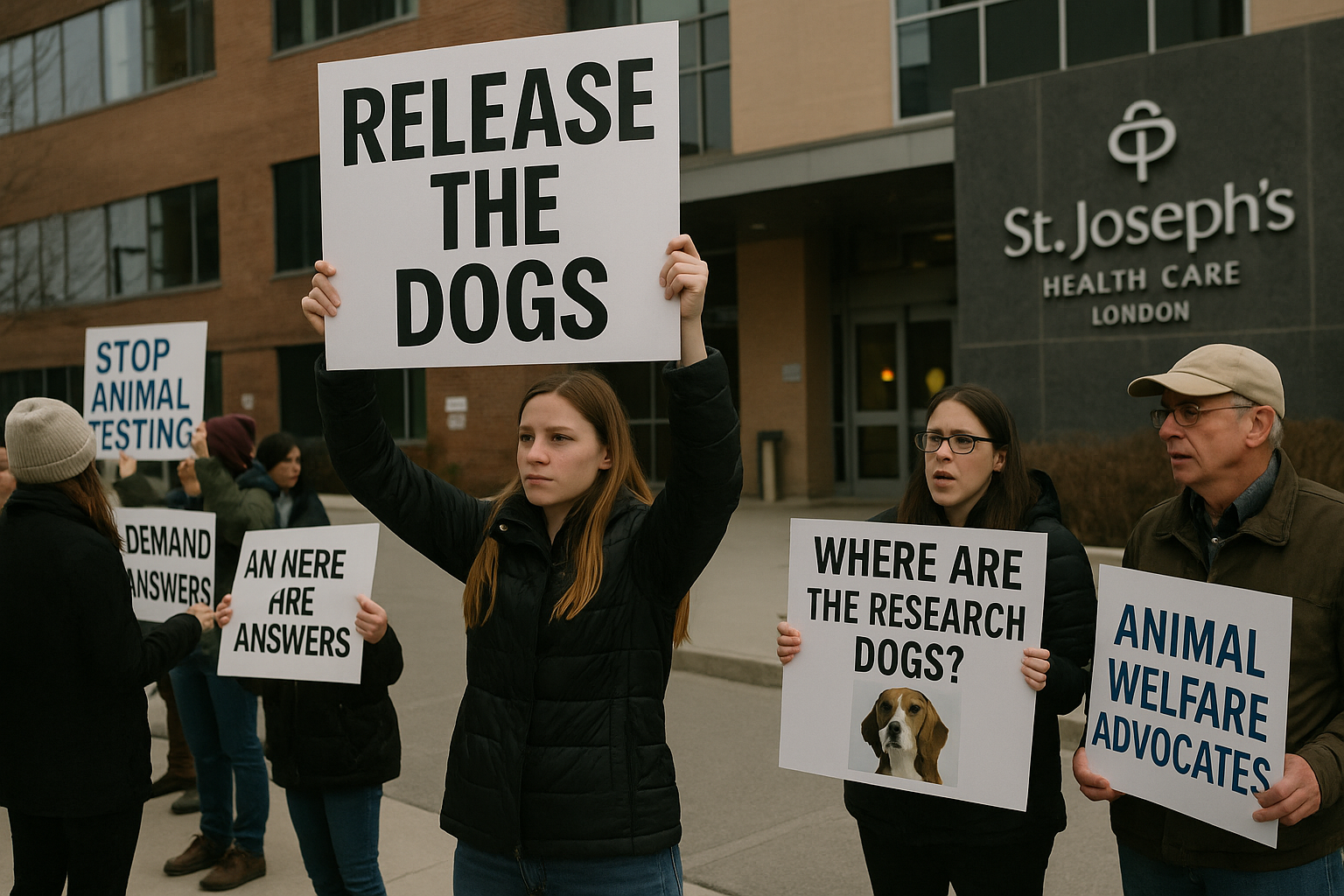
Animal welfare rarely sits quietly. It barks, it marches, and sometimes it stands politely outside hospital doors holding signs that ask uncomfortable questions. That scene unfolded Friday at St. Joseph’s Health Care, where advocates gathered to demand clarity on the fate of dogs once used in medical research. The issue is simple on the surface. Where are the dogs? The answers, however, have been slower than a vet visit on a Monday morning.
At the heart of the debate lies a growing public insistence on transparency, accountability, and ethical follow-through. When research ends, responsibility does not. That belief drove a modest but determined protest—and reignited a broader conversation about animal research in modern medicine.
Protest Outside Hospital Sparks Renewed Scrutiny
Approximately 30 animal welfare advocates assembled outside the front entrance of St. Joseph’s Health Care on Friday, staging what they called a “Release the Dogs” protest. Their goal was not disruption. It was disclosure.
The demonstration followed months of unanswered questions surrounding eight dogs previously used in cardiovascular research at the hospital. Protesters carried signs, spoke with passersby, and directed their message squarely at hospital leadership.
Why now? Because silence has a way of amplifying suspicion.
St. Joseph’s responded later that day with a community update, addressing concerns that had been circulating since summer. According to the hospital, six of the eight dogs are currently housed with an external organization and are being prepared for adoption. The remaining two dogs, the statement said, are still under the care of the Animal Care Committee at Western University.
For many advocates, the update was a start—but not a finish.
What St. Joseph’s Says Happened to the Dogs
In its statement, St. Joseph’s Health Care sought to clarify the situation and calm public concern. The hospital confirmed that all eight dogs are accounted for and emphasized that none were euthanized following the conclusion of the research.
H3: Six Dogs Headed Toward Adoption
According to the hospital, six dogs were transferred to an organization experienced in rehabilitating and rehoming animals that have participated in research. These dogs are reportedly undergoing behavioral assessments, socialization, and medical evaluations to prepare them for adoption.
This process, while time-consuming, is standard practice. Dogs used in controlled research environments often require additional care before transitioning into home settings. Think of it as retirement training—minus the gold watch.
H3: Two Dogs Remain Under University Care
The other two dogs remain with Western University’s Animal Care Committee. St. Joseph’s did not specify why these dogs have not yet been transferred, citing ongoing oversight and welfare considerations.
That explanation, while procedural, did little to fully satisfy critics. Advocates argue that without independent verification or timelines, reassurances feel incomplete.
As comedian George Carlin once quipped, “Scratch any cynic and you will find a disappointed idealist.” The advocates, it seems, are both.
Advocates Demand Verification, Not Assurances
Co-organizer Mackenzie Kirschner was among those calling for greater transparency. Speaking outside the hospital, she expressed concern over what she described as inconsistent or delayed information.
“As far as we know, two dogs remain in that hospital, and six are missing,” Kirschner said. “We’re here today to encourage the release of the remaining two and to verify the whereabouts of the other six.”
Her words cut to the core issue. Trust. Without clear documentation or third-party confirmation, official statements can feel abstract.
Advocates are not merely asking where the dogs are. They are asking to see proof. Paper trails. Adoption partnerships. Timelines. In an era where a food truck can be tracked in real time, why should accountability lag behind?
It is a fair rhetorical question. And one that resonates beyond this single protest.
The Research That Sparked Public Backlash
The controversy traces back to August, when an investigation by the National Post Investigative Bureau revealed that Lawson Research Institute—St. Joseph’s research arm—had been using dogs to study heart attacks in humans.
The revelation struck a nerve.
Animal research, while regulated, occupies a fraught ethical space. Supporters argue it saves lives. Critics counter that alternatives exist and should be prioritized. In this case, public sentiment tilted sharply toward discomfort.
The response was swift. Social media lit up. Emails flooded in. And within weeks, St. Joseph’s announced it would cease all research studies involving dogs.
That decision was framed as a commitment to evolving scientific practices and public values. Yet for many, the announcement raised a follow-up question that refused to go away. What happens to the animals now?
A Fictional Morning That Feels Familiar
Imagine this. A nurse finishes a night shift and scrolls through the news on her phone while sipping burnt coffee. She pauses at a headline about research dogs. She thinks of her own rescue mutt at home—the one who panics during thunderstorms and insists on sleeping sideways across the bed.
She wonders, briefly, what those research dogs experienced. Were they scared? Curious? Bored?
It is a small moment. Fictional, yes. But emotionally accurate.
This is how public issues become personal. Not through policy papers, but through quiet associations that linger longer than headlines.
The Larger Ethical Conversation
The St. Joseph’s case sits within a broader shift in biomedical research. Advances in computer modeling, synthetic tissues, and non-animal testing methods are changing what is possible. Slowly, but steadily.
Institutions are being asked to justify not only the necessity of animal research, but also their exit strategies. What happens after the data is collected? After the funding ends?
Transparency is no longer optional. It is expected.
As author Margaret Mead famously observed, “Never doubt that a small group of thoughtful, committed citizens can change the world.” The protest outside St. Joseph’s may have been small. Its implications are not.
Hospital Accountability and Public Trust
St. Joseph’s Health Care has taken steps to address concerns. Ending dog-based research was significant. Issuing a public update was necessary.
Still, trust is built incrementally. It thrives on details. It grows when institutions anticipate questions rather than react to them.
Advocates are not asking for perfection. They are asking for openness. A timeline for adoption. Confirmation from partner organizations. Clear welfare standards for the remaining dogs.
These are not radical demands. They are modern expectations.
Conclusion: Transparency Is the New Baseline
The story of St. Joseph’s research dogs is still unfolding. The hospital says all eight animals are safe. Advocates say verification matters as much as assurance.
Both can be true.
What is clear is that public tolerance for ambiguity has waned. In healthcare, as in animal welfare, credibility is earned through clarity.
The protestors will likely keep asking questions. The hospital will likely keep issuing updates. Somewhere in between lies an opportunity—not just to resolve a dispute, but to set a higher standard.