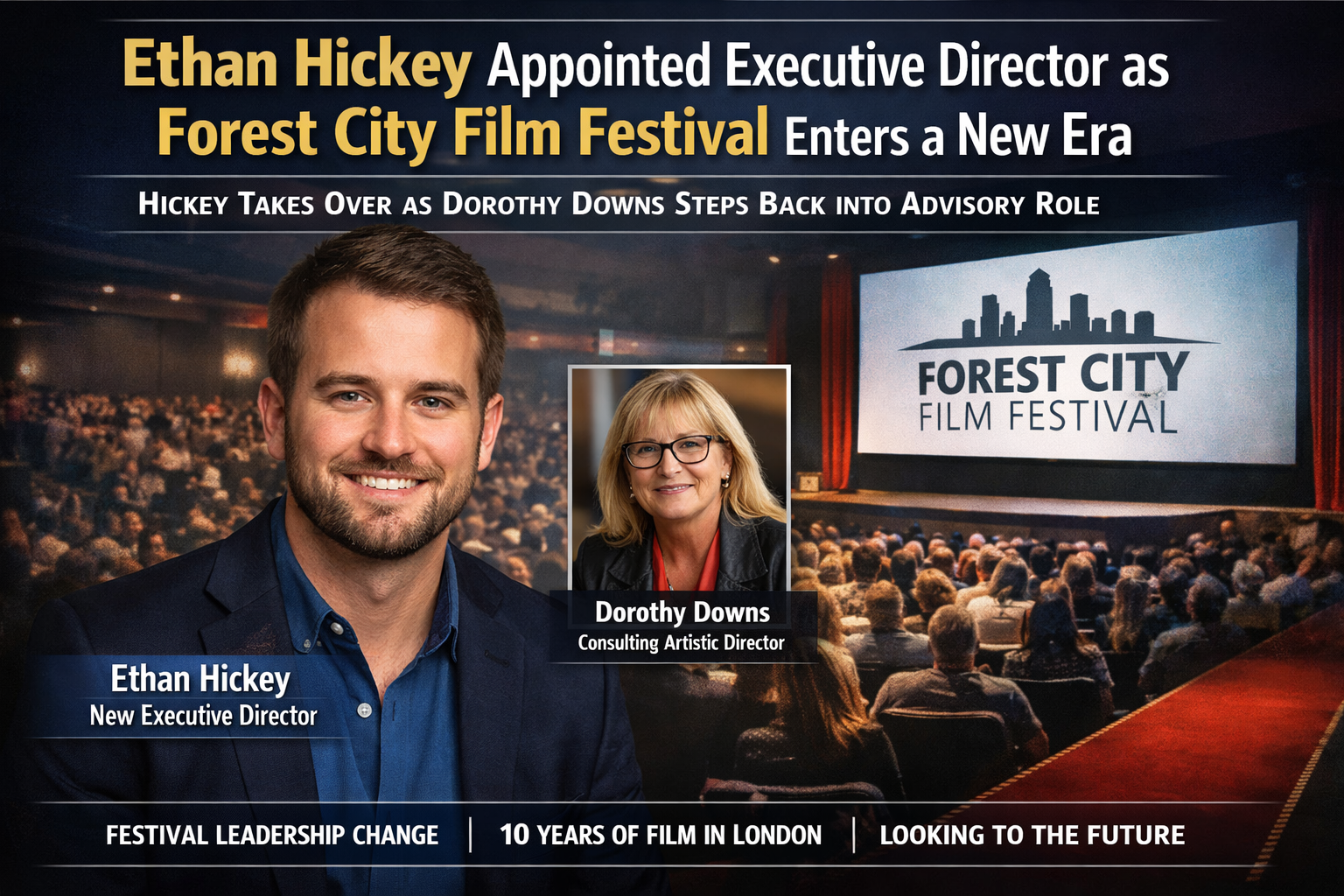
The Forest City Film Festival is entering a pivotal chapter. Leadership is changing. Momentum remains intact. And expectations are quietly rising.
After a decade of steady growth, community trust, and creative risk-taking, the festival has announced a significant leadership transition. Ethan Hickey has been named Executive Director, stepping into the role previously held by Dorothy Downs, who is moving into a new advisory position.
The handoff signals continuity rather than disruption. Yet it also hints at evolution. Film festivals, much like films themselves, succeed when they know when to cut, when to linger, and when to shift perspective.
A Decade That Redefined a City’s Relationship With Film
Founded in 2015, the Forest City Film Festival was never meant to be small in spirit. It began modestly, yes. A kitchen table. A notebook. A city hungry for its own stories.
Dorothy Downs saw the gap early. London, Ontario had talent. Southwestern Ontario had voices. What was missing was a stage.
“What began as an idea at my kitchen table grew into a vibrant, multi-venue, multi-day celebration,” Downs said in a statement announcing the transition.
That line lands because it’s true. Anyone who has attended FCFF remembers the early years. Folding chairs. Overstuffed schedules. Lines that wrapped around corners in October drizzle. The kind of logistical chaos that only passion can justify.
As comedian Jerry Seinfeld once joked, “People don’t want to hear about the labor pains. They want to see the baby.” FCFF delivered the baby. Every year.
Dorothy Downs Steps Back—But Not Away
A Strategic Shift, Not a Goodbye
Downs is not leaving the festival. She is repositioning.
Her new role as Consulting Artistic Director allows her to continue shaping the festival’s creative vision while stepping away from the operational demands of executive leadership. This distinction matters. Burnout is real. Vision fatigue is real. Smart founders know when to recalibrate.
After ten years at the helm, Downs leaves behind a festival that is financially stable, nationally recognized, and deeply rooted in its community.
That’s not accidental. That’s stewardship.
In private conversations, festival insiders often recount how Downs could spot a promising short film within minutes. One programmer joked that she “had a sixth sense—and a seventh for budget spreadsheets.” Leadership like that is rare.
Ethan Hickey Takes the Director’s Chair
Experience Meets Institutional Memory
Ethan Hickey is not an outsider parachuting in. He knows the terrain. He understands the audience. He has worked within the festival’s ecosystem and beyond it.
His appointment reflects confidence from the board and trust from the creative community. Those two groups don’t always agree. When they do, it’s usually a good sign.
Hickey steps into the role at a moment of opportunity. The festival is entering its 11th year. The brand is established. The audience is loyal. The question now is scale, relevance, and sustainability.
Can FCFF grow without losing its soul? That’s the real test.
The Challenge of Year Eleven
Why the Second Decade Is Harder Than the First
The first ten years are about survival. The next ten are about significance.
Film festivals across North America face real pressures. Rising costs. Audience fragmentation. Streaming fatigue. Shortened attention spans. Ask any festival director off the record and they’ll sigh before answering.
Hickey inherits these challenges. He also inherits a gift: goodwill.
One longtime volunteer shared a fictional-but-familiar anecdote that captures the mood. During last year’s festival, a projector failed minutes before a premiere. Panic brewed. Hickey reportedly rolled up his sleeves, joked that “this is why film is still magic,” and helped troubleshoot until the lights came back on. The room applauded—not for the fix, but for the calm.
Leadership shows itself in moments like that.
Community First, Always
Why Local Stories Still Matter
FCFF was built on a simple premise: local stories deserve professional platforms.
That hasn’t changed.
Southwestern Ontario filmmakers often struggle for visibility. Larger festivals can feel impenetrable. FCFF offers something different. Access. Conversation. Belonging.
This focus aligns with broader industry shifts. Audiences are craving specificity again. Authenticity. Films that feel lived-in rather than engineered.
As author Annie Dillard once wrote, “How we spend our days is, of course, how we spend our lives.” FCFF spends its days championing regional voices. That’s a mission worth protecting.
What Changes—and What Doesn’t
Operational Evolution Under New Leadership
Hickey’s appointment does not signal a radical overhaul. Expect refinement, not reinvention.
Industry observers anticipate incremental changes. Expanded partnerships. Smarter use of digital platforms. Possibly new programming streams. But the core remains intact.
Multi-venue screenings will continue. Music and film will remain intertwined. Community engagement will stay central.
If anything, Hickey’s leadership style is expected to emphasize collaboration. Listening before acting. Asking the uncomfortable questions.
What does success look like now? Bigger audiences? Better funding? Deeper impact?
Probably all three.
The Festival’s Broader Cultural Role
More Than Screenings
FCFF is not just about films. It’s about economic activity. Tourism. Creative retention.
Cities that invest in culture tend to keep talent. They also tell better stories about themselves.
London, Ontario has often struggled with identity. Festivals like FCFF help clarify it. This is a city that creates. A region that speaks.
That matters more than ticket sales alone.
Looking Ahead With Measured Optimism
Transitions are risky. They are also necessary.
Dorothy Downs leaves behind a blueprint. Ethan Hickey brings fresh eyes. Together, their overlap creates stability.
There’s a quiet confidence in how this change has been handled. No drama. No abrupt exits. Just thoughtful succession.
That alone speaks volumes.
As one attendee quipped after hearing the news, “If the credits are rolling and the next scene looks promising, why leave the theatre?”
Conclusion: A Festival Still in Motion
The Forest City Film Festival is not pausing. It is recalibrating.
Leadership transitions often reveal the true strength of an organization. In this case, the signals are encouraging. Experience remains. Energy arrives.
Ethan Hickey steps into the director’s role with a steady hand. Dorothy Downs continues shaping the creative soul. The community watches, hopeful and engaged.