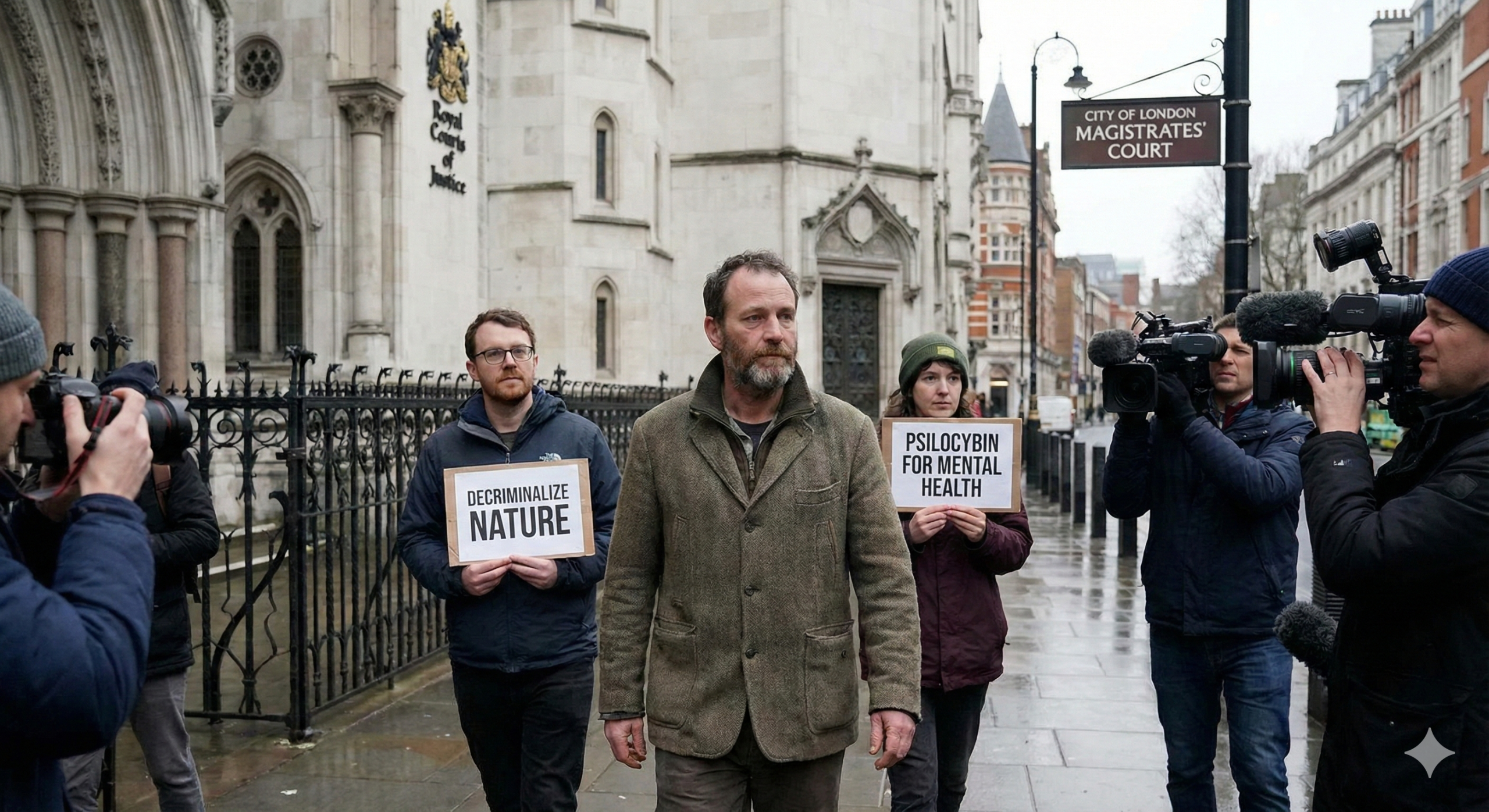
A London court has handed down a significant fine to a man who operated a downtown magic mushroom dispensary, bringing an end to a closely watched legal case that raised constitutional questions about drug laws and freedom of thought. The sentencing follows the rejection of a constitutional challenge earlier this year and reinforces the current legal framework governing psilocybin in Canada.
The case, which stems from a 2023 police raid on a Richmond Street storefront, has drawn public attention due to its intersection of criminal law, emerging debates around psychedelic substances, and arguments over personal beliefs versus established legislation.
Background of the Case
The legal proceedings centered on Samer Akila, who operated the Fun Guyz Magic Mushrooms store in downtown London, Ontario. The store, which openly sold psilocybin products, became one of several similar establishments operating in a legal grey area across parts of the country.
Police Raid and Charges
In June 2023, London police executed a raid at the Richmond Street location as part of an investigation into the sale and distribution of psilocybin. Following the operation, Akila was charged with possession of psilocybin for the purpose of trafficking, an offence under federal drug laws.
Psilocybin, commonly referred to as magic mushrooms, remains a controlled substance in Canada. While there has been growing discussion about its potential therapeutic uses, its possession and sale are still illegal outside of narrow exemptions granted for specific medical or research purposes.
Storefront Operations Under Scrutiny
The Fun Guyz storefront operated openly, drawing both customers and critics. Supporters viewed the store as part of a broader movement advocating for the decriminalization or legalization of psychedelic substances, while opponents and law enforcement officials emphasized that the operation violated existing laws.
The high-profile nature of the store made it a focal point for broader debates around drug policy, enforcement priorities, and the pace of legal reform.
Constitutional Challenge Rejected
A central element of Akila’s defence involved a constitutional argument that sought to challenge the legality of psilocybin restrictions in Canada.
Freedom of Thought Argument
Akila argued that laws prohibiting the use and distribution of psilocybin infringed on freedom of thought. His position was rooted in the belief that psilocybin can promote mental clarity, personal insight, and psychological well-being, and that restricting access to such substances interfered with an individual’s ability to explore consciousness.
The defence maintained that criminalizing psilocybin amounted to an unjustified limitation on personal autonomy and intellectual freedom.
Court’s Response to the Challenge
Earlier this year, the court rejected the constitutional challenge, determining that existing drug laws do not violate freedom of thought in the manner argued by the defence. The ruling affirmed Parliament’s authority to regulate controlled substances in the interest of public health and safety.
With the constitutional argument dismissed, the case proceeded toward sentencing based solely on the established offence.
Sentencing Hearing and Crown’s Position
The sentencing hearing took place last month and focused on determining an appropriate penalty for the offence.
Crown Seeks Substantial Fine
During the hearing, the federal Crown argued that a strong financial penalty was necessary to reflect the seriousness of the offence and to deter similar conduct. Prosecutors requested a fine of $20,000, emphasizing that Akila knowingly operated a business that trafficked in a prohibited substance.
The Crown highlighted that the store functioned as a commercial operation rather than a minor or isolated incident, making the offence more serious in nature.
Defence Argues for Leniency
The defence took a markedly different position, asking the court to impose a fine of $1,000. Defence counsel pointed to Akila’s personal beliefs regarding psilocybin, his advocacy efforts, and the broader public conversation around psychedelic substances.
It was also noted that Akila no longer resides in Canada, having since moved to Egypt, a factor raised during discussions about sentencing practicality.
Judicial Decision and Rationale
Justice George Orsini delivered his decision remotely via Zoom, outlining the court’s reasoning and emphasizing the importance of upholding the law regardless of personal viewpoints.
Court Emphasizes Seriousness of the Offence
In his remarks, Justice Orsini made it clear that personal opinions about psilocybin do not diminish the gravity of the offence. He stated that Akila’s belief in the benefits of the substance did not make the crime any less serious under the law.
The judge underscored that knowingly engaging in the trafficking of a controlled substance carries inherent risks and consequences, particularly when conducted through a retail operation accessible to the public.
Fine Set at $10,000
After weighing the arguments from both sides, the court ordered Akila to pay a fine of $10,000. The amount fell midway between the penalties proposed by the Crown and the defence, reflecting a balance between deterrence and proportionality.
The fine serves as the final outcome of the case, formally closing the legal proceedings related to the Richmond Street operation.
Broader Implications for Psilocybin Advocacy
The decision carries broader significance for individuals and groups advocating for changes to Canada’s drug laws, particularly those surrounding psychedelic substances.
Legal Boundaries Remain Clear
Despite growing interest in the therapeutic potential of psilocybin, the ruling reinforces that current laws remain firmly in place. Courts have continued to distinguish between emerging scientific research and unauthorized commercial distribution.
The case signals that advocacy efforts must operate within legal channels and that open retail sales of controlled substances will continue to attract enforcement action.
Ongoing Public Debate
Psilocybin has gained increasing attention in recent years, particularly in discussions around mental health treatment for conditions such as depression and post-traumatic stress disorder. While some limited exemptions exist for medical use, broad legalization or decriminalization has not yet occurred at the federal level.
Cases like this one highlight the tension between evolving public attitudes and the existing legal framework, a gap that continues to generate debate across the country.
Impact on Local Enforcement and Community
The Fun Guyz case also reflects the approach taken by local law enforcement and the judiciary in addressing unauthorized dispensaries.
Message to Similar Operations
By imposing a significant fine, the court’s decision sends a clear message to other operators considering similar business models. Even in the absence of jail time, financial penalties and criminal convictions carry lasting consequences.
Authorities have consistently maintained that enforcement actions are necessary to uphold public safety and regulatory consistency.
Community Reaction
Public reaction to the case has been mixed. Some community members view the outcome as a reasonable enforcement of the law, while others see it as an example of outdated policies failing to keep pace with scientific and social change.
Regardless of perspective, the ruling provides clarity on how courts are likely to handle similar cases moving forward.
Conclusion: Case Underscores Limits of Advocacy Through Civil Disobedience
The sentencing of Samer Akila marks the conclusion of a case that blended legal advocacy with civil disobedience. While the arguments raised about freedom of thought and the potential benefits of psilocybin contributed to public discourse, the court ultimately reaffirmed that personal beliefs do not override established law.
With a $10,000 fine imposed, the decision underscores the risks faced by those who choose to challenge drug laws through direct action rather than legislative reform. As conversations around psychedelics continue to evolve, the case stands as a reminder that meaningful change must occur within the legal system, not outside of it.